Home »
Articles
Writing With AI Without Sounding Like AI: A Workflow That Holds Up
Last updated : June 29, 2026
Most advice about using AI for writing stops at either extreme. On one end: "Just have ChatGPT write it and run it through a humanizer." On the other: "Never use AI, it destroys your voice." Both miss what working writers, editors, and content teams actually do, which is use AI carefully, as one step in a larger process, and end up with work that's recognizably theirs.
This post is about that middle workflow. It's what we use ourselves, and it's what we'd recommend to a content team being asked to scale without losing voice. Six steps, in order, each with a specific job. None of them is a detector-dodging trick. All of them are editorial choices that happen to also produce text detectors that don't flag.
Here's the whole workflow at a glance before we dig into each step:
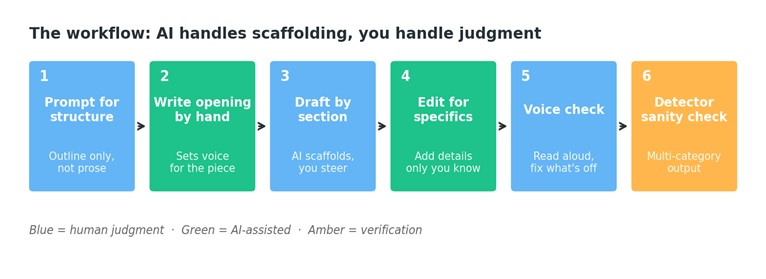
The six-step workflow. Human judgment anchors steps 1, 2, 4, and 5. AI scaffolds steps 3. Step 6 is a final verification pass, not a decision point.
The principle underlying the workflow
Before the steps, the thing that makes the workflow work.
AI is useful for the parts of writing that are mechanical: structure, first-pass scaffolding, turning bullet points into prose, and summarizing research. AI is bad at the parts of writing that are about judgment: voice, opinion, specificity, knowing what to leave out. The workflow is built to let AI do the first kind of work and hand the second kind back to you at the right moment.
If you let AI do judgment work, you get generic content that reads as AI. If you do mechanical work by hand, you waste time that should go into the parts only you can do. The workflow below is about sorting the two.
Step 1: Prompt for structure, not prose
When you start a piece with AI, don't ask for a draft. Ask for an outline. Specifically: "Give me five H2 section headers for a 1,200-word piece on [topic], aimed at [audience], with the main argument being [X]."
You'll get back a structure. Read it. Fix whatever's wrong. Reorder. Cut headers that are redundant. Add ones the AI missed. This takes two minutes and sets the shape of the piece before you've written a single sentence.
Doing this right means the piece is already structurally yours before AI touches the prose. Structural fingerprints are what detectors catch most reliably. Fix the structure at step one, and you've already cleared the single biggest risk.
Step 2: Write your opening paragraph by hand
Not most openings. Every opening. No exceptions.
The first 80 words of a piece set the voice. Readers (and detectors) calibrate to them. If the opening is AI, the rest of the piece will feel AI even when the body is good. If the opening is yours, a lot of small imperfections downstream get read as stylistic choice rather than machine output.
This is the one step you can't skip if you care about voice. It's also, honestly, the step most people skip because it takes the longest. Write the opening. Then let AI help with the rest.
Step 3: Use AI for the middle sections, section by section
Instead of asking AI to draft the whole piece, draft one section at a time. For each section, give it:
- The H2 header
- The specific point that the section needs to make
- Any examples, statistics, or references you want included
- The tone of the opening paragraph (so it has something to calibrate to)
Section-by-section drafting produces better output for the same reason it produces better work from human writers: you're forced to know what each section is actually for before you start generating. Broad "write me 1,200 words on X" prompts produce broad, unfocused, AI-shaped prose. Focused prompts produce focused, specific prose.
Step 4: Edit for specifics, not words
Most people edit AI drafts by rephrasing sentences. That's the wrong level.
Edit AI drafts by adding specifics. Every paragraph should end with at least one concrete detail that couldn't have been generated, a number, a date, a name of a tool or company, a quote, or a specific example from your own experience. This is the editorial move that most reliably pulls a draft out of the AI zone, and it's the one detectors can't catch up to because specifics aren't a stylistic pattern. They're ground truth.
If a paragraph in your draft could have been written about any industry, any company, or any audience without changing a word, it's AI-shaped and needs specifics added, regardless of what the detector says.
We do this with a highlighter pass. Print the draft (or use a comment feature). Highlight every sentence that's generic. Rewrite those sentences with specifics; leave the rest alone. Takes about 20 minutes for a 1,200-word piece and does more for voice than any amount of rephrasing.
Step 5: Run a voice check, not a detector check
Before you run anything through a detector, run the draft past the check that actually matters: does this sound like you?
Read it out loud. Read it silently with the question "Would I have written this sentence?" in mind. Pay attention to any paragraph where you wouldn't defend the phrasing as your own.
If you find one, don't try to detector-proof it. Rewrite it. The voice check catches what the detector would have caught, and more, and fixing it at this stage produces text that holds up for readers, not just for tools.
Step 6: Now run the detector check
Only at the end, and only as a sanity check.
Run the finished piece through a detector to see where it lands. We'd recommend one with multi-category output rather than a binary score, because the honest result for most AI-assisted content is somewhere in the middle bucket. QuillBot AI Detector returns three categories: AI-generated, Human-written & AI-refined, and Human-written, and its RAID leaderboard score of 0.997 makes it a reasonable benchmark. Full leaderboard here.
If your piece lands mostly in "Human-written" with a small "AI-refined" slice, the workflow did its job. If it's mostly "AI-refined," that's also an honest outcome and fine for most contexts; the piece is human-led and AI-polished, which is what you actually made.
If it comes back mostly "AI-generated," something in your workflow skipped. Most likely, you let AI do step 2 (the opening) or step 4 (the specifics). Go back and fix the step, not the output.
What this workflow gets you
A few things worth naming:
- Content that reads as yours because structurally and specifically, it is yours. AI handled the scaffolding; you handled the judgment
- Work that holds up across detector updates, because it's genuinely human-led rather than disguised
- A process that scales for content teams, because every step has a clear owner and checkpoint
- Faster production than either pure human drafting or pure AI-plus-humanizer, because nothing is being done twice
In Summary
Writing with AI well is a skill, not a shortcut. The people getting the most out of AI right now are the ones treating it as a writing partner with clear strengths and clear weaknesses, good for structure and scaffolding, bad for voice and judgment. The workflow above is how you make that division of labor explicit.
Detector output is just a side-effect of doing the work properly. Do the work, and the rest follows.
Frequently asked questions
Does this workflow actually save time compared to writing from scratch?
Yes, but less than you'd hope. In our experience, the 6-step workflow cuts production time by roughly 30–40% compared to hand-drafting, not the 80% that lazy AI workflows promise. The savings come from step 3 (AI-scaffolded middle sections) and step 1 (structure prompting). The other steps are where quality lives, and they take real time. If you're looking for a 10x speedup, you'll get AI-shaped content. If you're looking for sustainable gains without losing voice, this is what the honest math looks like.
Can a content team actually run this at scale?
Yes. The step-by-step structure is what makes it work. Each step has a clear owner (writer does 1, 2, 4, 5; AI does 3; editor runs 6), which means the workflow is reviewable at every checkpoint. Teams that try to run AI drafting without this kind of stepped structure end up with inconsistent voice across writers and unclear accountability when something ships poorly. The workflow looks slow on paper, but scales cleaner than ad-hoc AI usage.
What if my detector score comes back mostly in the AI-refined bucket?
That's usually fine. AI-refined is the honest label for most AI-assisted writing in 2026: a human drafted it, AI polished it, and a human edited again. Unless your brief specifically requires zero AI involvement (and we'd gently push back on contracts that ask for that), an AI-refined result means the workflow did roughly what it was supposed to. Mostly "AI-generated" is the signal that something skipped. Mostly "Human-written" is better-than-expected. Anywhere in between is normal.