Home »
Python »
Python Programs
Adding dummy columns to the original dataframe
Given a pandas dataframe, we have to add dummy columns to the given dataframe.
Submitted by Pranit Sharma, on September 25, 2022
Pandas is a special tool that allows us to perform complex manipulations of data effectively and efficiently. Inside pandas, we mostly deal with a dataset in the form of DataFrame. DataFrames are 2-dimensional data structures in pandas. DataFrames consist of rows, columns, and data.
Problem statement
Suppose, we are given a DataFrame of students with multiple attributes like roll number, name, year of admission, etc. We need to add a dummy column in this DataFrame.
Adding dummy columns in a dataframe
Dummy columns in pandas contain categorical data into dummy or indicator variables. These are used for data analysis. In most cases, this is a feature of any action being described.
To add columns / dummy columns in a DataFrame, you can use pd.get_dummies() method inside the pd.contact() method by specifying the column name and axis. Consider the below-given syntax:
pd.concat([df, pd.get_dummies(df['Year_of_admission'])], axis=1)
To get a dummy column, we must use pandas.get_dummies(), this method returns all the dummy values of each column passed as a series inside it.
Let us understand with the help of an example,
Python program to add dummy columns to the original dataframe
# Importing pandas package
import pandas as pd

# Importing numpy package
import numpy as np

# Creating a dictionary
d = {
    'Roll_no':[101,102,103,104,105],
    'Name':['Ram','Faizal','Ankur','Sheetal','Tushar'],
    'Age':[20,19,20,18,19],
    'Year_of_admission':[2019,2019,2020,2020,2020]
}

# Creating a DataFrame
df = pd.DataFrame(d)

# Display Original DataFrames
print("Created DataFrame:\n",df,"\n")

# Adding dummy column
df = pd.concat([df, pd.get_dummies(df['Year_of_admission'])], axis=1)

# Display result
print("Modified DataFrame:\n",df)
Output
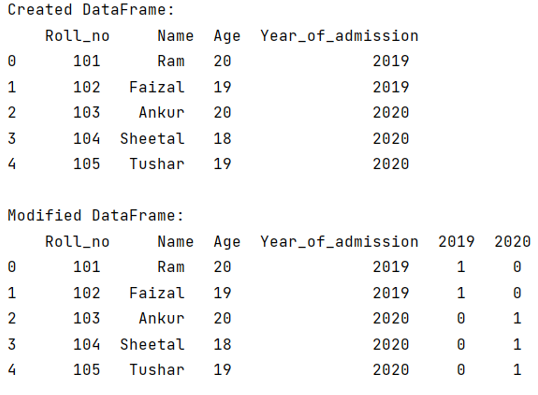
The output of the above program is:
Python Pandas Programs »